GTO Wizard review
Verdict
GTO Wizard is the most complete poker study platform I have used. If you study seriously, go straight to Elite; for many players, though, the Premium plan ($99 a month, $79 on yearly billing) is enough. Elite ($169 a month, $139 yearly) adds the best features on the platform: an AI solver that finished every two-player spot I ran in under five seconds, and nodelocking. A cheaper route is Premium plus a desktop solver such as GTO+ for custom solves and nodelocks, rebuilding the starting ranges from Wizard's library yourself. Whichever you pick, start with a month and move up a tier when the plan starts holding you back.
| If you are… | Buy | Why |
|---|---|---|
| Curious, or new to solvers | Free | PokerArena, a limited library and a feel for the interface |
| Learning fundamentals at micro stakes | Starter ($49/mo) | Basic 100bb library, unlimited 100bb practice, weekly coaching; analyzer capped at 100 hands a month |
| A regular grinder on a budget | Premium ($99/mo) | Full heads-up library incl. ante and straddle, aggregated flop and turn reports, 100,000 analyzed hands a month |
| A serious reg (my pick) | Elite ($169/mo) | AI solver, nodelocking, player profiles, 150,000 analyzed hands a month |
| Studying multiway spots in depth | Ultra ($359/mo) | Multiway preflop solving up to 9 players, 3-way postflop solving (not tested for this review) |
The biggest drawbacks: no flop reports for Single Size solutions (and none planned), add-on costs for custom reports, and an analyzer that counts deliberate exploits as mistakes.
Overall score: 4.5/5. Almost every feature earns full marks; the half point goes for the add-on costs and the missing Single Size reports.
How I tested, and what you should know about me
I am a professional cash-game player. Online I play NL200 on GGPoker and up to NL500 on another site, and live I have played up to NL2K. I have studied with solvers for about nine years: four years on GTO+, then five on PioSolver.
I have been around GTO Wizard for about two years. Our study group's coach runs two sessions a week on it, and I sometimes work through spots with a friend on his Elite account. For this review I used it hands-on myself: a week on Elite during GTO Wizard's Open Week (16–23 November 2026), then a paid Premium subscription. I uploaded 40,000 of my own GG NL200 hands and took about 70 screenshots along the way.
Ultra-only features were not available to me, so I describe them but do not score them.
I also use GTOStrategy, for about a month now, and mention it where it does something differently.
Disclosure. I paid for the Premium subscription myself. The Elite access came from GTO Wizard's Open Week, which was free for every user, and GTO Wizard did not know about or review this article. At the time of writing I have no affiliate relationship with GTO Wizard or GTOStrategy. If affiliate links are added later, we may earn a commission when you buy through them, at no extra cost to you; scores will not change because of it, and this note will be updated.
Pricing and plans
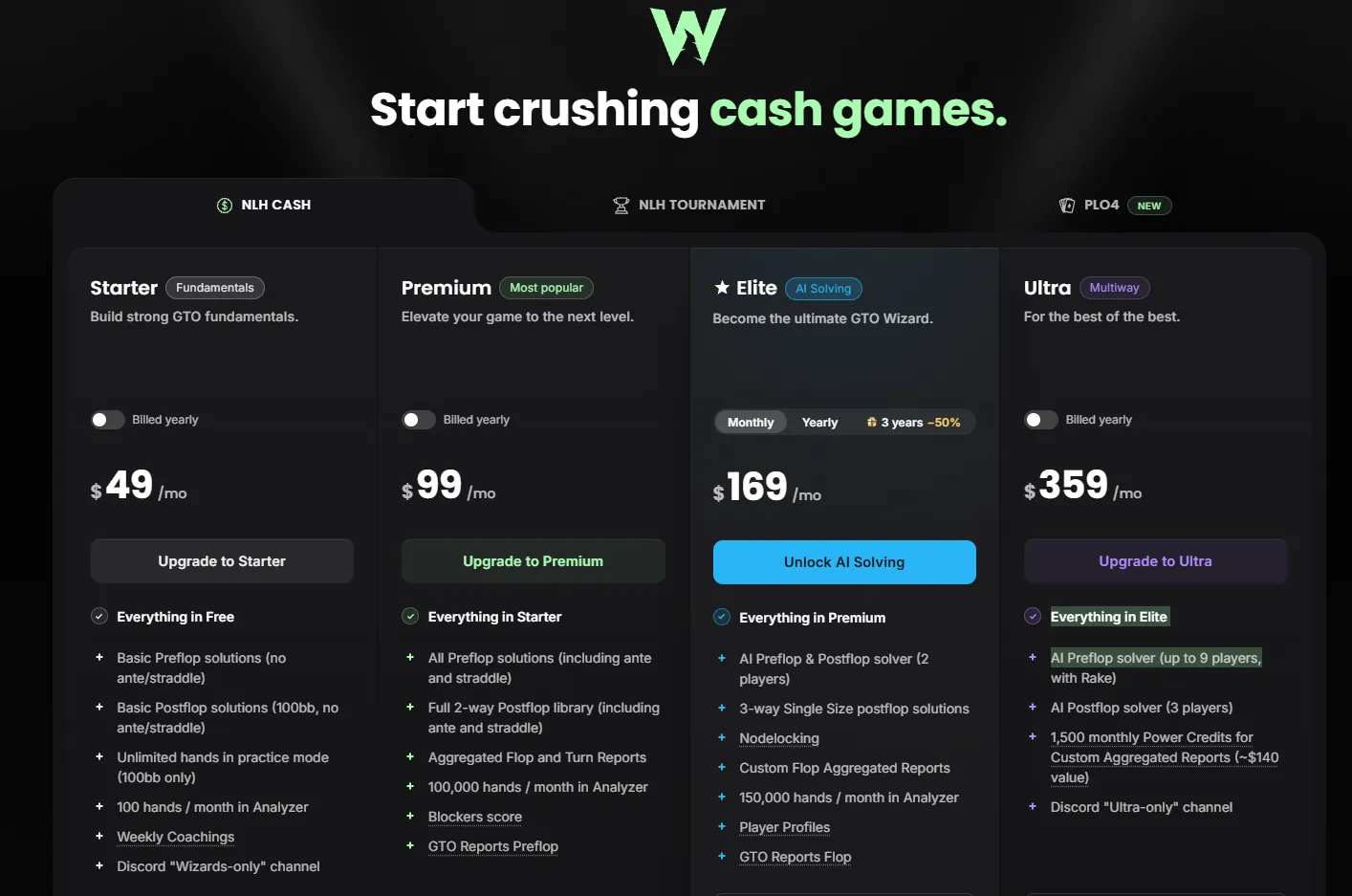
NLH Cash plans run from $49 to $359 a month; yearly billing cuts every tier by about 20%. Each tier includes everything in the one below it.
| Plan | Monthly | Yearly (per month) | What it adds |
|---|---|---|---|
| Free | $0 | $0 | PokerArena, limited solutions and tools |
| Starter | $49 | $39 | Basic preflop (no ante/straddle), basic 100bb postflop, unlimited 100bb practice, 100 analyzer hands a month, weekly coaching, Discord |
| Premium | $99 | $79 | All preflop incl. ante and straddle, full heads-up postflop library, aggregated flop and turn reports, 100,000 analyzer hands a month, blockers score |
| Elite | $169 | $139 | AI preflop and postflop solver (2 players), nodelocking, player profiles, 3-way Single Size postflop, 150,000 analyzer hands a month |
| Ultra | $359 | $289 | AI preflop solver up to 9 players with rake, 3-player postflop solver, 1,500 Power Credits a month (about $140 of custom reports) |
Elite is also sold as a three-year plan at 50% off. Tournament and PLO plans are priced separately. There is no free trial of paid plans; the free account plays that role. Prices as shown on GTO Wizard's pricing page in November 2026.
Solution library
The library covers almost any cash format you will meet, and its GG setups match what I actually see at NL200. Score: preflop 5/5, postflop 5/5.
Preflop. You choose heads-up, 6-max, 8-max or 9-max; classic, short deck, ante or several straddle variants; stacks from 20bb to 300bb; open sizes from 2x to 3x; with or without cold calls. The GG reg-table setup uses 2x opens from LJ and HJ, 2.3x CO, 2.5x BTN and 3x SB, with 3-bets of 6.5x from HJ and CO and 7.5x from the button.
The catch: GG-specific ranges exist only for NL50 and NL500, not NL200, and only as Single Size solutions. In practice the three stakes differ mostly in mixed hands, which I adjust to the table anyway, so this matters less than it sounds.
Postflop: Single Size vs Multi Size. Single Size solutions, added in March 2026, use one bet size per decision. Multi Size gives up to five. On Kh8d2c in a 3-bet pot, Single Size has the preflop raiser range-bet half pot; Multi Size splits the same range across five sizes from 25% to 120% of the pot.
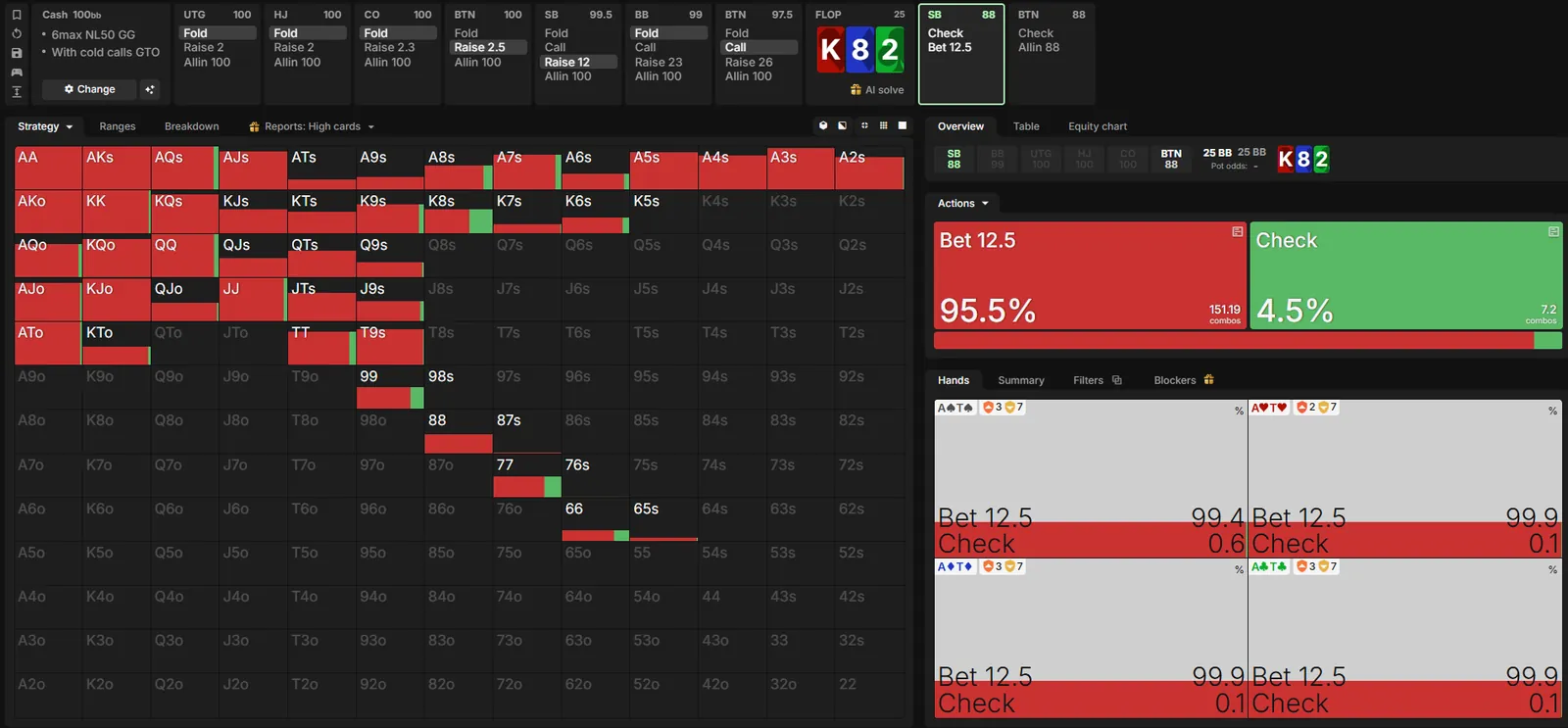
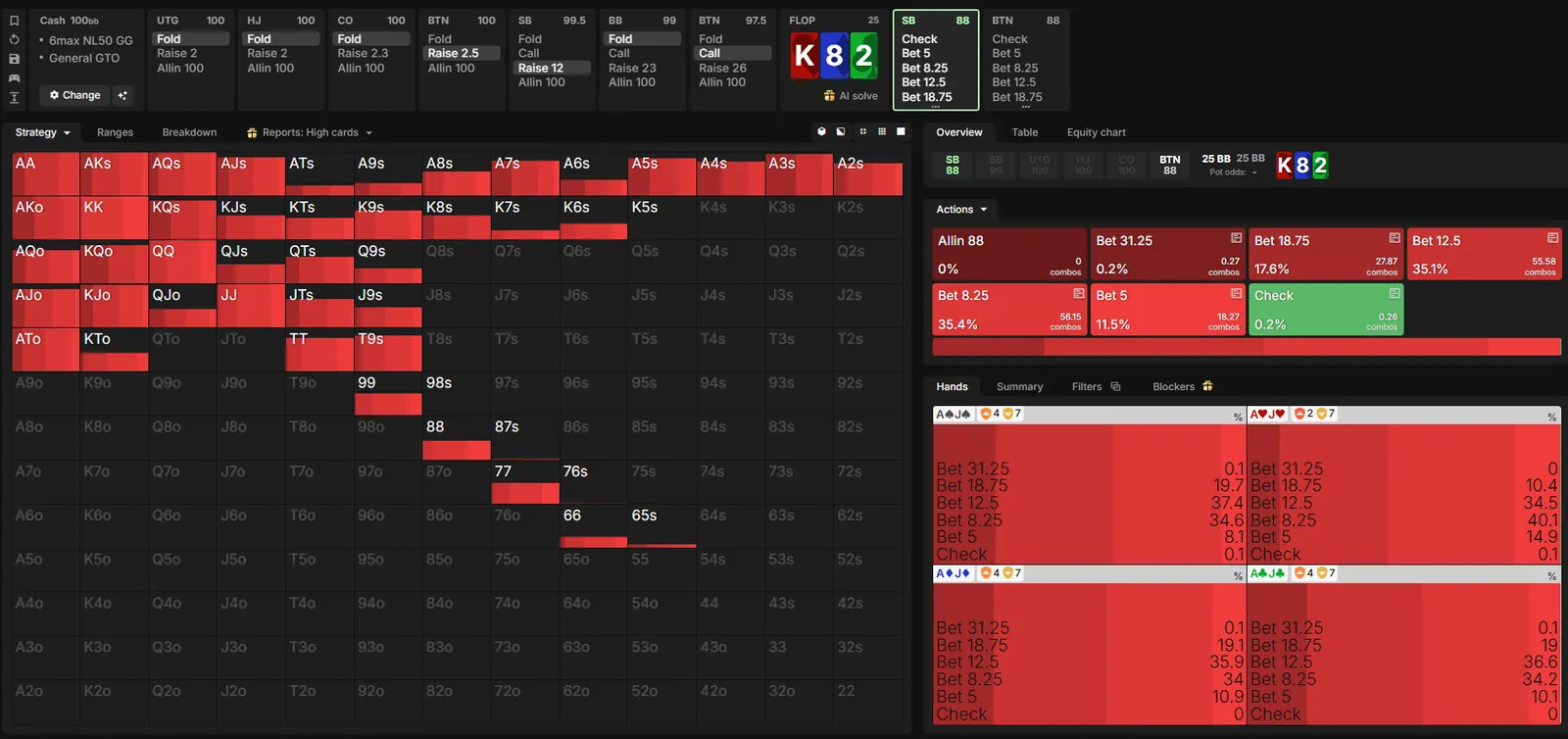
I play one size on the flop because it is far easier to remember and, in my experience, costs very little EV. From the turn on I want two or three sizes. The library offers either Single Size on every street or Multi Size on every street. The mix I prefer is only available through custom solving on Elite. Competitors such as GTOStrategy build exactly that structure into their library.
Case study: the all-in check-raise. On BTN vs BB Jd8d3c (Single Size), the button c-bets 6.4bb into 5.5bb 35% of the time, and the big blind's only check-raise size is all-in. When I custom-solved the same spot with several sizes, the solver preferred about 2.2x and practically never shoved.
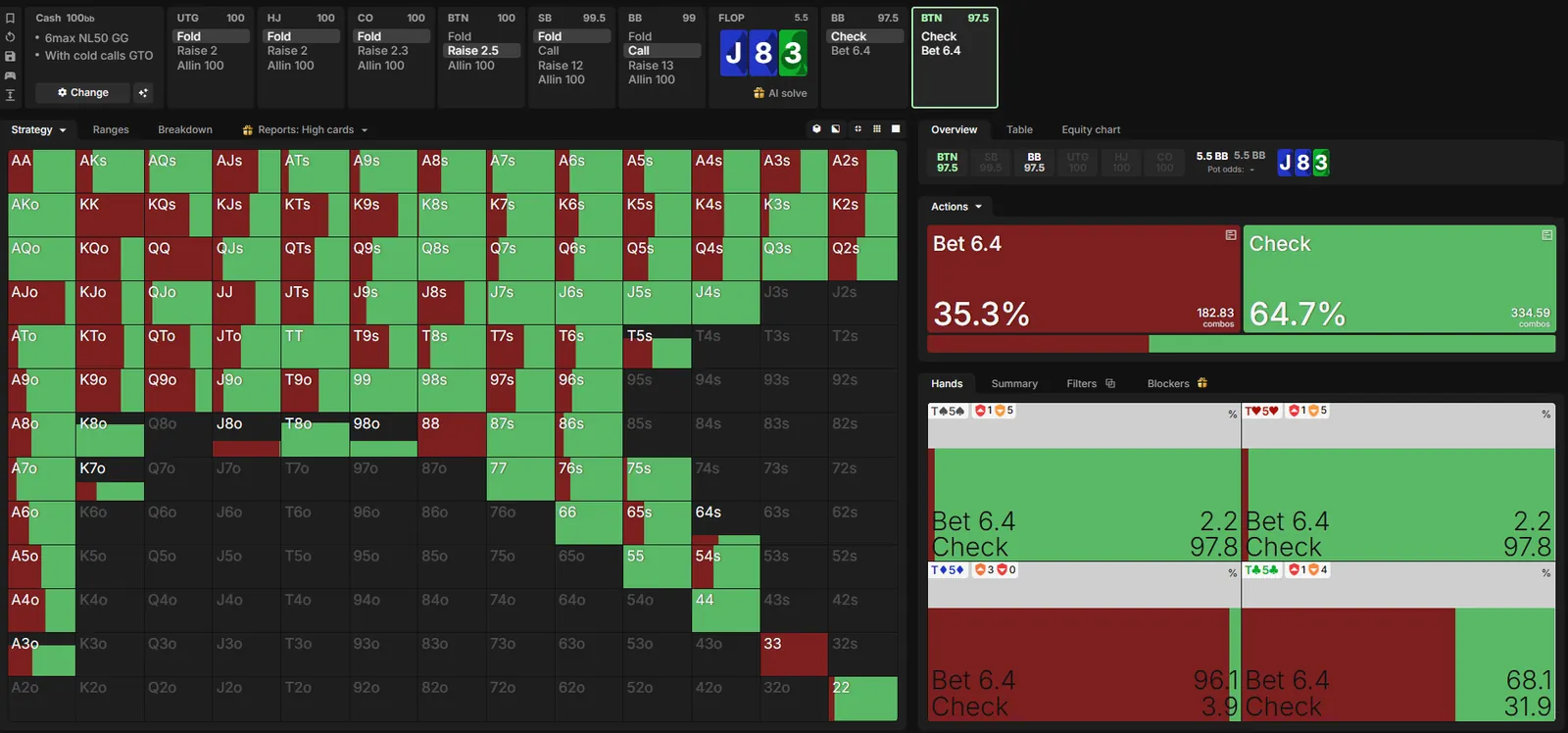
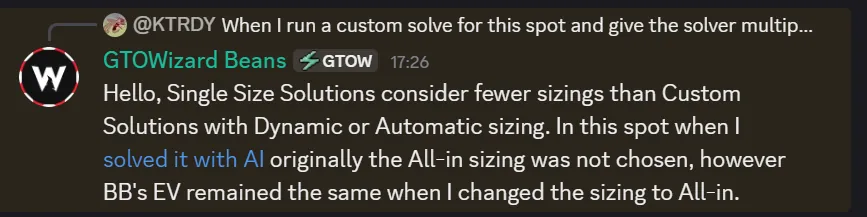
I asked support on Discord. Their answer: Single Size trees consider fewer sizes, and the big blind's EV stayed the same when the size was changed to all-in. The lesson is to read the EV, not just the chosen size: a simplified tree can show a size that looks strange and still be correct.
Aggregated reports
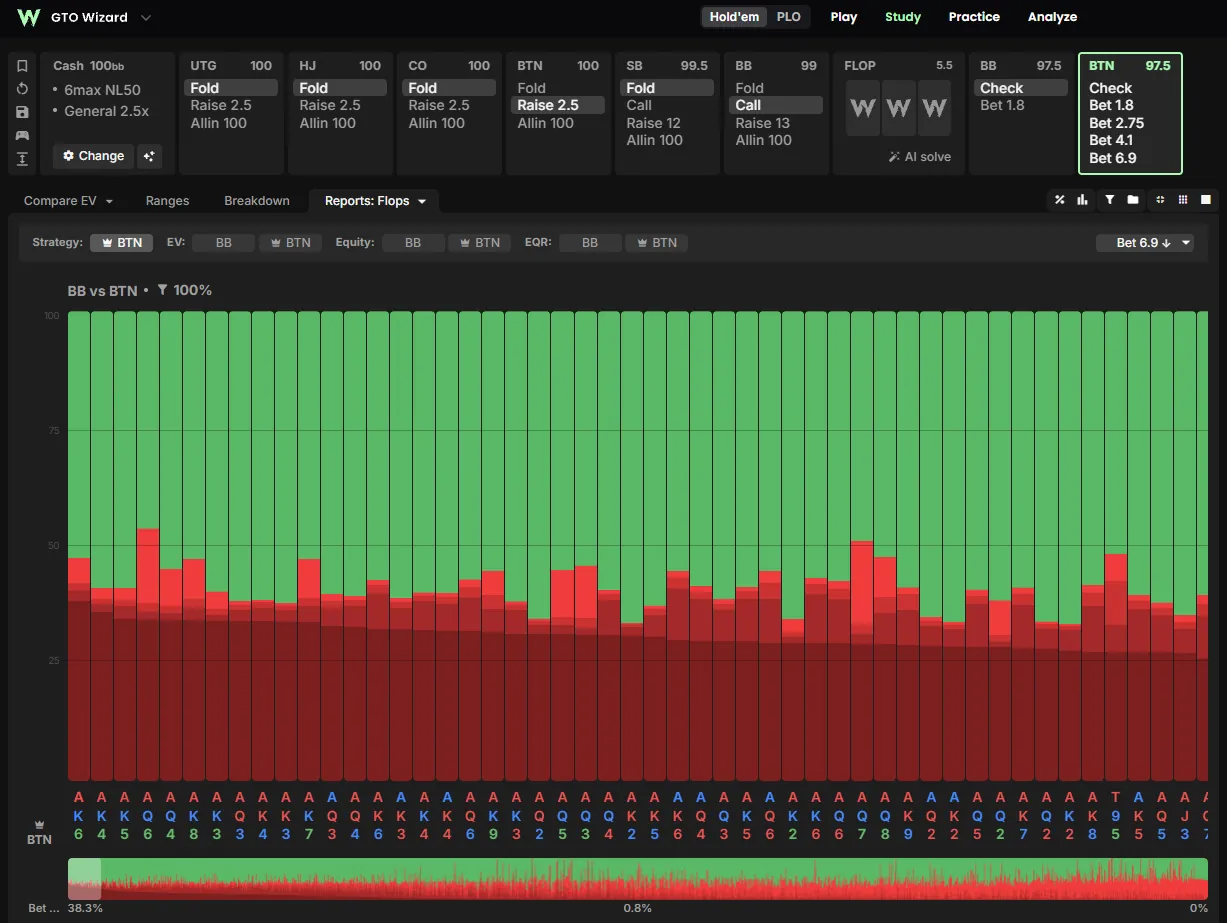
Aggregated reports are the fastest way I know to learn flop strategy as a whole, but they exist only for Multi Size solutions. Score: 4/5.
A report shows one spot across every flop at once. For BTN vs BB in a single-raised pot, with sizes of roughly 33%, 50%, 75% and 125% of the pot, I could sort all flops by any action. The 125% overbet peaks at 38% on A-high boards such as AK6 and drops to zero on others. You can switch between strategy, EV, equity and equity realization for either player. For a newer player this is the quickest way to see where your range has the advantage and can c-bet a lot, and where it has to check.
The problem: there are no flop reports for Single Size solutions, which GTO Wizard itself promotes as the simpler way to play. The team's answers on Discord changed over 2026: none available (April), “considering adding them” (June), and “no plans to add them at the moment” (July). If you play one flop size like I do, you study reports for a strategy you do not use.
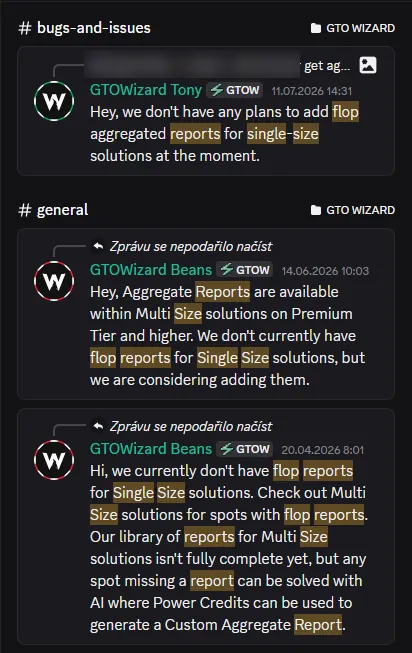
In April 2026 GTO Wizard also said the Multi Size report library was not yet complete. Spots without a report, and any custom report, are paid for with Power Credits: 250 credits (about one report) cost $25, 1,100 cost $100, and 6,000 cost $500. Ultra includes 1,500 credits a month; Elite does not.
AI solver, nodelocking and player profiles (Elite)
The AI solver is the best tool on the platform: every two-player spot I ran, including wide ranges, solved in under five seconds. Score: AI solver 5/5, nodelocking 5/5. My one complaint is that it starts at Elite; at $99 a month, I think Premium should include at least some custom solving.
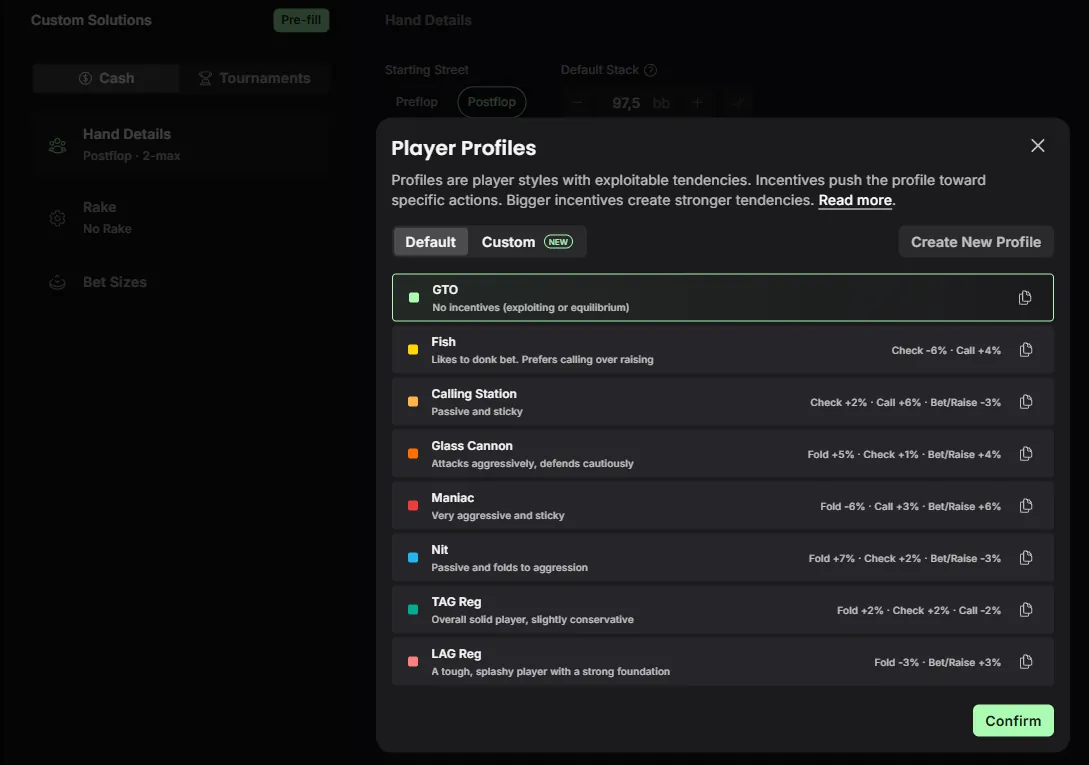
You set stacks, pot, rake, ranges and bet sizes, and can give each player a profile. There are seven built-in profiles (Fish, Calling Station, Glass Cannon, Maniac, Nit, TAG reg and LAG reg), each a fixed nudge toward certain actions; a Nit, for example, folds 7% more and bets or raises 3% less. You can also save your own profiles.
Case study: one read, opposite conclusions. I took a single-raised pot, UTG vs BB on J73, 98bb deep with 5% rake capped at 8bb. UTG c-bets 3bb and the big blind check-raises to 11.8bb. I then solved UTG's response four ways.
First, with the big blind's profile set to Maniac, then to Nit. Second, with a manual nodelock based on my own read of NL200: I locked the whole big blind range at GTO, then removed six low-frequency air check-raises (QTs, Q9s, KTs, K9s, A5s, A4s) and made JJ check-raise more.
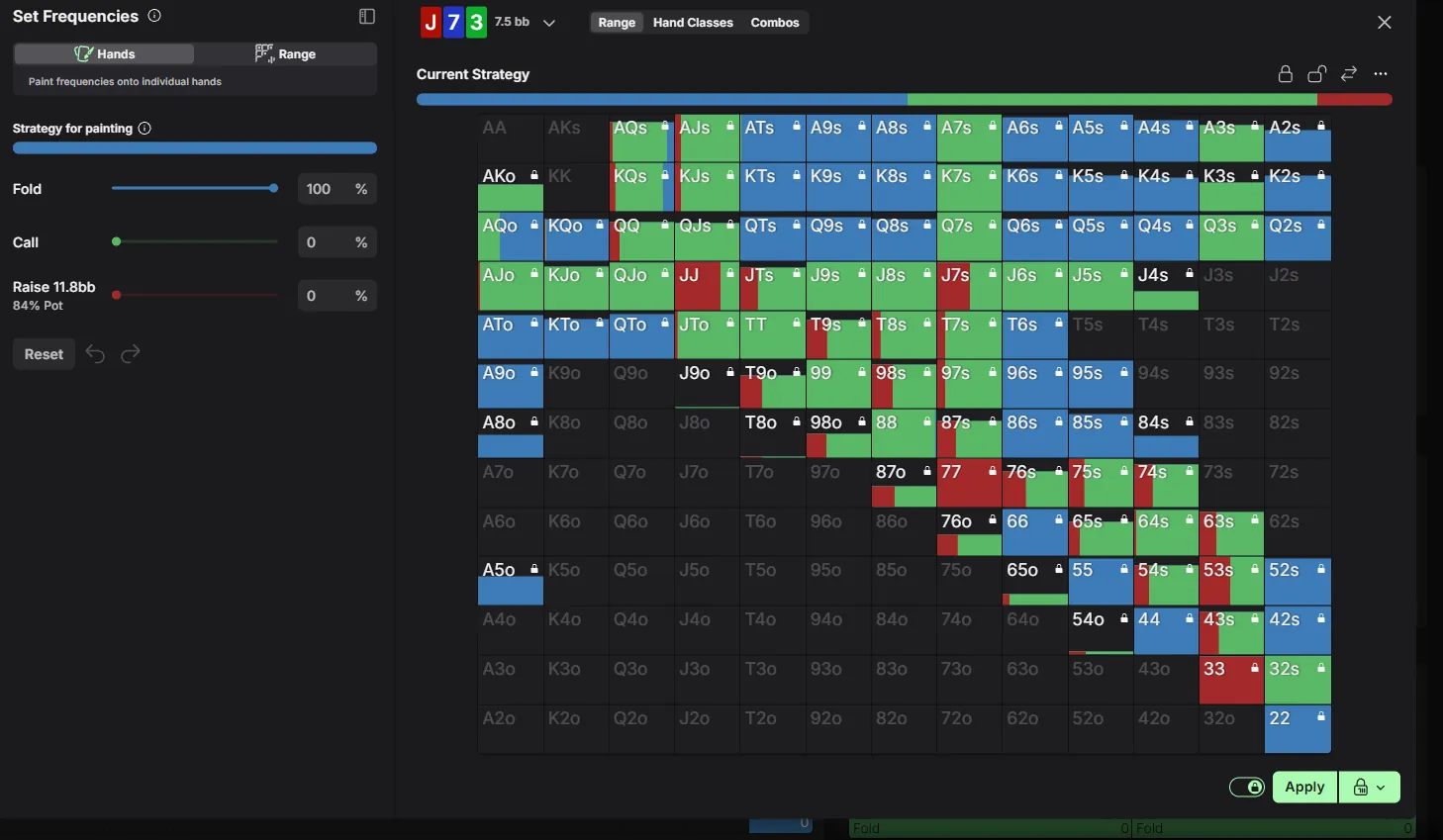
The Nit profile tells UTG to 3-bet the check-raise more, because a nit folds to aggression. My read says the opposite: if those bluffs are missing, UTG should fold far more and almost never 3-bet. Profiles are a good start, but they do not replace a specific read.
One warning from my own testing: the tool does not stop you from building a nonsense lock. My first attempt left JJ folding a third of the time to a 3bb c-bet, and my second forgot to lock JJ at all. Each mistake moved UTG's fold frequency by a few points.
Trainer and drills
The trainer is close to addictive, and it is the part of GTO Wizard I would miss most. Score: 5/5. Unlimited practice is included from Starter, though only at 100bb.
You can play full hands, a single spot or a single street, and build drills around the spots that give you trouble, mark them and come back to them. I like playing four tables at once: it feels closer to a real session and you get through more hands. Speed goes up to a turbo setting, a learning mode can pause after each mistake, and a frequency mode is useful for drilling mixed preflop decisions.
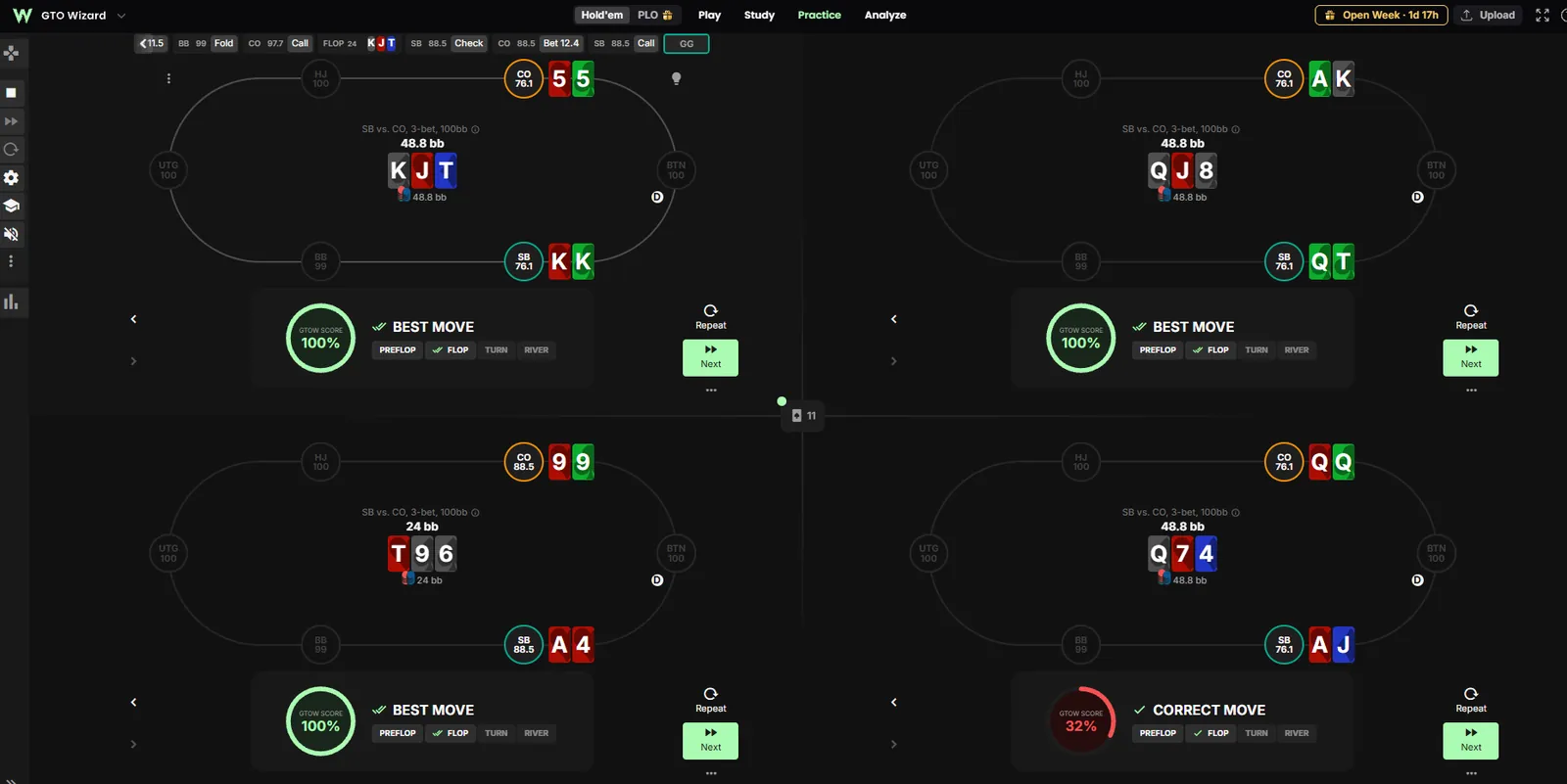
What is missing is the why. The trainer tells you that a combo should bluff or check-raise, but not why this combo and not another one. More explanation would help beginners most; this is exactly what GTOStrategy is trying to do.
Hand analyzer: 40,000 of my own NL200 hands
The analyzer found my real leaks within minutes, and its filters are the best part of it. Score: 5/5.
Upload. GG hand histories went in without any conversion. On Premium, 40,372 hands uploaded in one go in about 5.5 minutes. The free account stopped twice at around 21,000 hands with a daily upload safety limit; support confirmed the limit exists and does not apply to Ultra, and on paid Premium I never hit it. Monthly analysis limits are 100 hands on Starter, 100,000 on Premium and 150,000 on Elite.
Results. Across 45,000 decisions my GTO score was 89.5%, with an average EV loss of 2.35bb per 100 hands. The pattern by street was clear:
| Street | Decisions | Perfect | Mistake + blunder |
|---|---|---|---|
| Preflop | 36,000 | 90.8% | 3.2% |
| Flop | 4,200 | 66.2% | 3.3% |
| Turn | 2,700 | 67.5% | 6.8% |
| River | 1,700 | 61.5% | 15.7% |
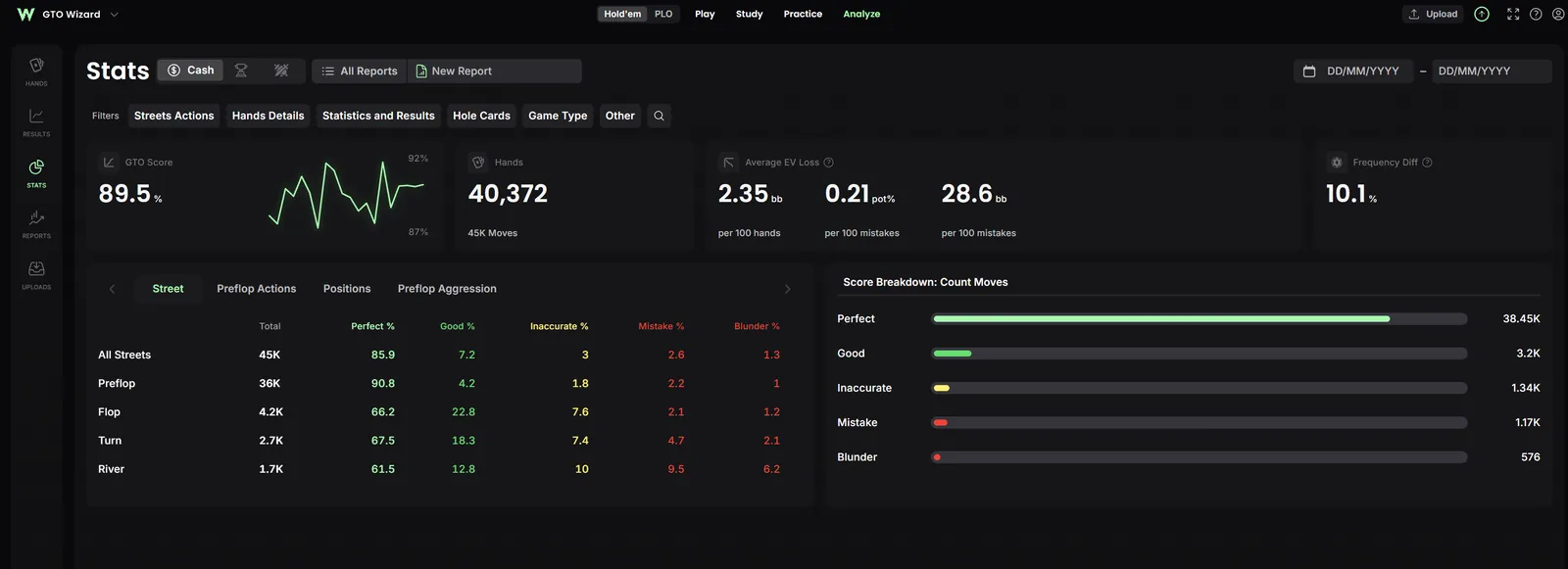
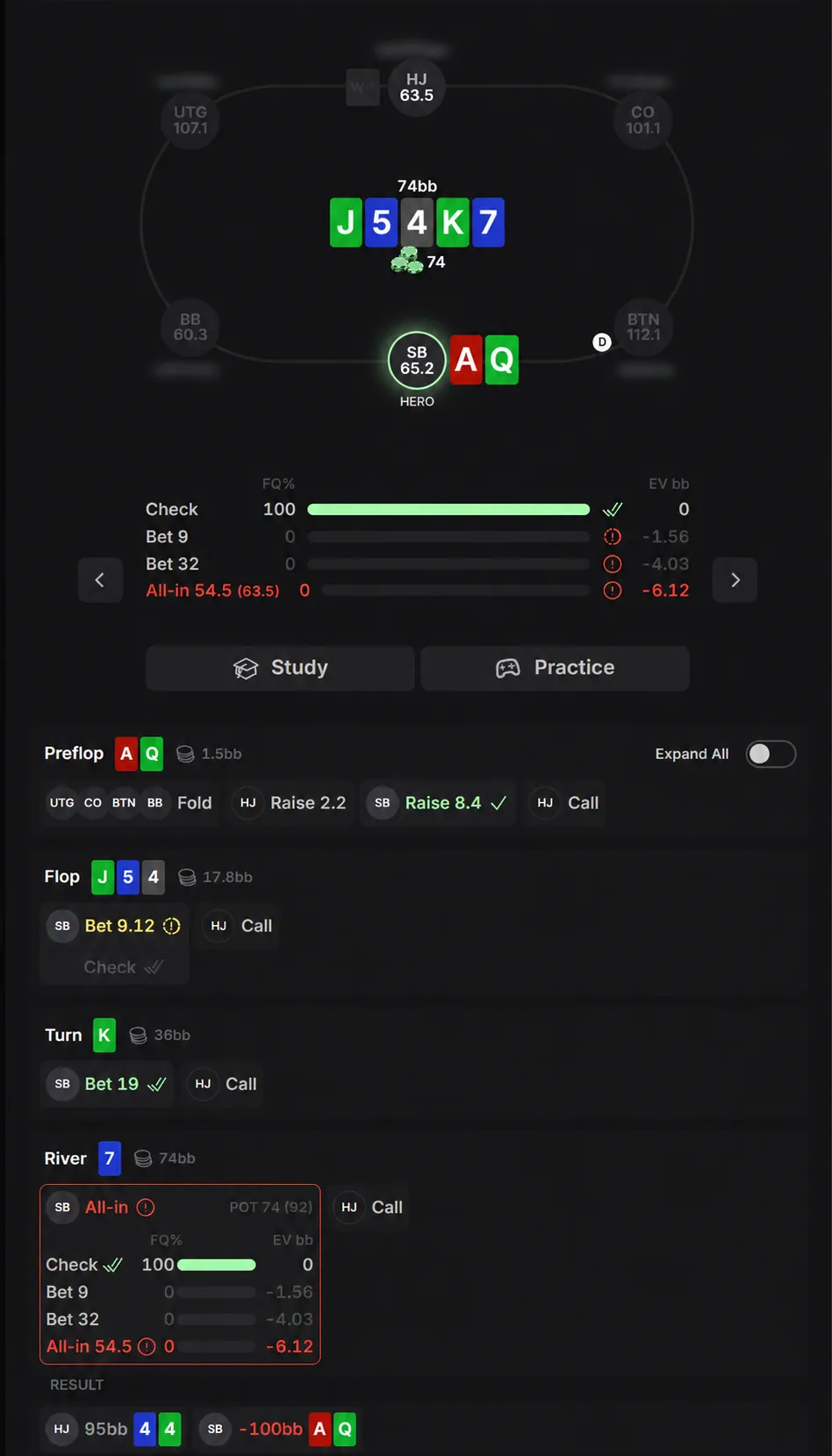
Finding the expensive hands. You can filter by street, action and GTO result, and every filter gets its own graph, hand heatmap and breakdown by position. My worst blunder was AQo in a 3-bet pot out of position on J54K7. My half-pot flop bet was a minor inaccuracy (the solver checks 87%, about 0.03bb better). The real mistake was my river shove: the solver checks 100%, and the shove cost 6.12bb of EV.
Filtering to hands where I saw the river and made a mistake showed two patterns. First, I am greedy on the river and pick bigger sizes than the solver. That is a real leak. Second, I overfold to aggression on the river, especially when I bet and an in-position player raises, whether all-in or smaller.
The second one is deliberate. In my opinion, shared by every pro I study with and discussed in our coaching, these lines are heavily underbluffed in the NL200 population. The analyzer cannot know that. It measures your distance from GTO, not from the best exploit, so it counts an intentional, profitable fold as a mistake. You have to read its output with your own reads in mind.
Multiway
The 3-way Single Size library on Elite changed how I think about multiway pots: I had been far too passive. Score: 5/5.
I learned long ago that you check a lot in multiway pots. The solutions say otherwise more often than I expected. With HJ opening, the button calling and the big blind calling, on 774 the big blind leads for about a third of the pot 24% of the time. Leads and stabs in multiway spots are sometimes surprisingly frequent.
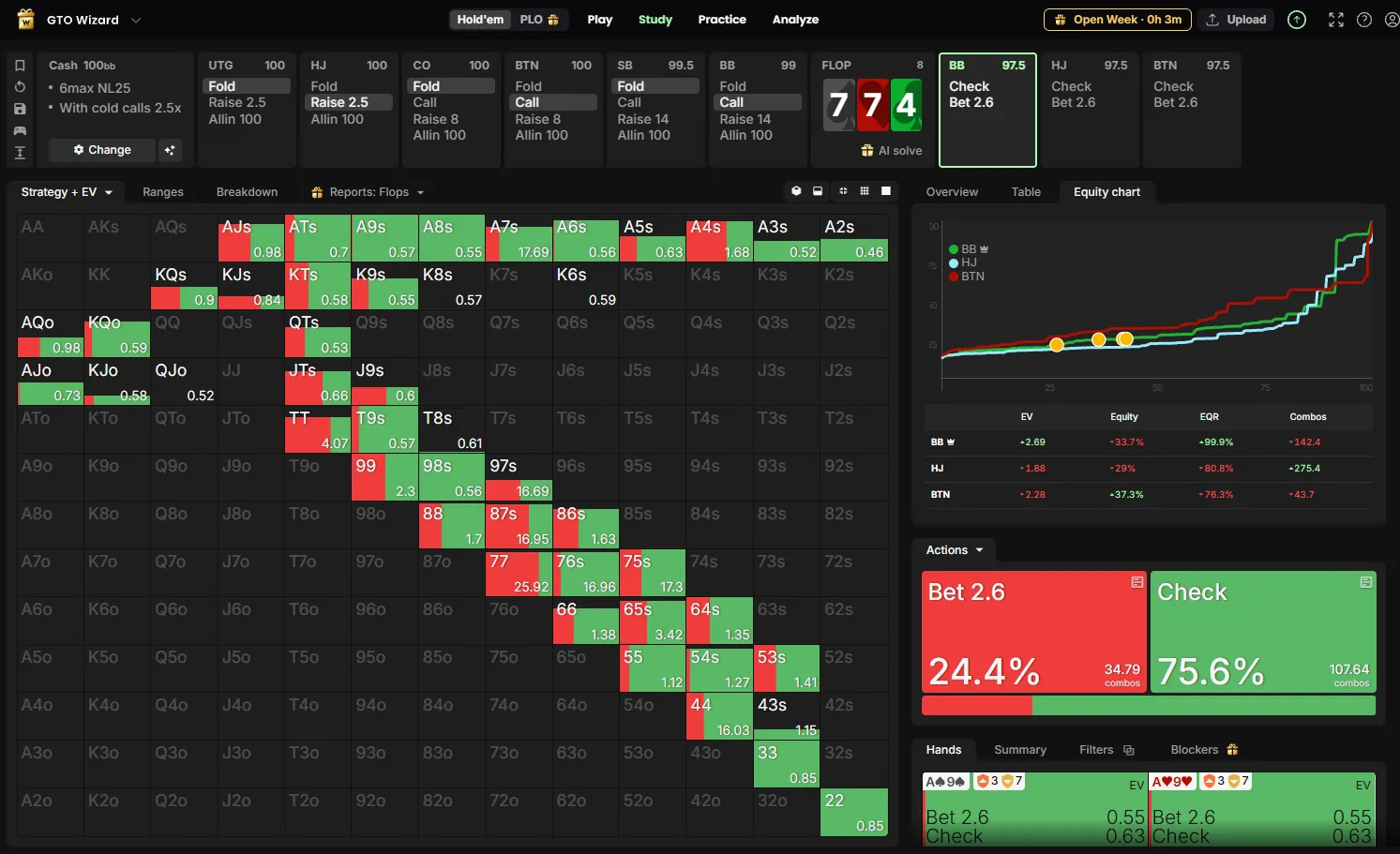
The library covers preset 3-way spots only. Solving your own 3-way spots, and multiway preflop solving with up to nine players, requires Ultra. I did not have Ultra, so I have not tested those features.
PokerArena, coaching, mobile and ease of use
The extras are strong, and the main thing holding beginners back is how much there is to learn.
PokerArena (free, 5/5). A free heads-up game with its own phone app, where you can play for prizes such as a month's subscription. Every hand you play lands automatically in the analyzer.
Coaching (from Starter, 5/5). Weekly live coaching sessions for cash and tournaments, with recordings and category filters. Cash coaches include Scrimitzu, Vanja, TheWakko and Kevin Rabichow.
Mobile (4/5). There is no native app; it runs in the browser. I found no features missing compared with the desktop, but the screen is simply too small for me to study on.
Ease of use (5/5). Fast and well designed. For a beginner it can be overwhelming: using every tool properly takes study. GTO Wizard helps with a free explanatory video for almost every tool.
Support and cancelling
Support answers fast and honestly, and cancelling takes about ten seconds. Score: support 5/5, cancelling 5/5.
Support runs through a Discord server with well-organized channels, open from Starter. I timed eight random questions in the bugs-and-issues channel: half were answered within 12 minutes, the rest within two to three hours, for a median of about 8.5 minutes. My own two questions were answered in about three hours on a Saturday and in 8 minutes on a Monday. During the busy Open Week they answered everything, from technical strategy questions to complete basics.
To cancel, go to Menu → Subscription, click the red “Cancel subscription” button at the bottom left and confirm twice. Your plan keeps running until the end of the paid period. Nothing is hidden, and there are no retention screens to fight through.
Hidden costs and limits
The pricing page does not tell the whole story. These are the limits I ran into that it does not show:
- Custom aggregated reports cost extra, even on Elite. They are paid with Power Credits: about $25 per report, $100 for 1,100 credits.
- No flop reports for Single Size solutions, and the team says there are no plans to add them.
- In April 2026 GTO Wizard said the Multi Size report library was not yet complete; spots without a report need a custom report paid with credits.
- Custom solving starts at Elite ($169 a month). Premium has no AI solver at all.
- Your own 3-way spots need Ultra ($359 a month).
- The free account has a daily upload limit of about 21,000 hands. Paid Premium took my 40,000 hands in one go.
Pros, cons and bottom line
Pros
- Covers almost every cash format, including GG reg-table setups
- AI solver solves two-player spots in under five seconds
- Nodelocking and player profiles turn reads into strategy
- Trainer with custom drills and up to four tables
- Analyzer handles 40,000 GG hands in minutes, with precise filters
- Fast, honest support; cancelling takes ten seconds
Cons
- No flop reports for Single Size solutions, and none planned
- Custom reports and missing spots cost extra credits
- No custom solving below Elite ($169 a month)
- Trainer shows what to do, rarely why
- Analyzer counts deliberate exploits as mistakes
- Steep learning curve for beginners
| Feature | From plan | Score |
|---|---|---|
| Preflop library | Starter | 5/5 |
| Postflop library | Starter | 5/5 |
| Aggregated reports | Premium | 4/5 |
| AI solver | Elite | 5/5 |
| Nodelocking | Elite | 5/5 |
| 3-way library | Elite | 5/5 |
| Trainer | Starter | 5/5 |
| Hand analyzer | Starter | 5/5 |
| PokerArena | Free | 5/5 |
| Coaching | Starter | 5/5 |
| Mobile | Starter | 4/5 |
| Ease of use | Free | 5/5 |
| Support | Starter | 5/5 |
| Cancelling | All paid plans | 5/5 |
If you play cash games seriously, GTO Wizard is worth paying for, and Elite is the plan I would buy. Premium is enough for many players, especially paired with a desktop solver for custom spots: try a month and move up when it holds you back.